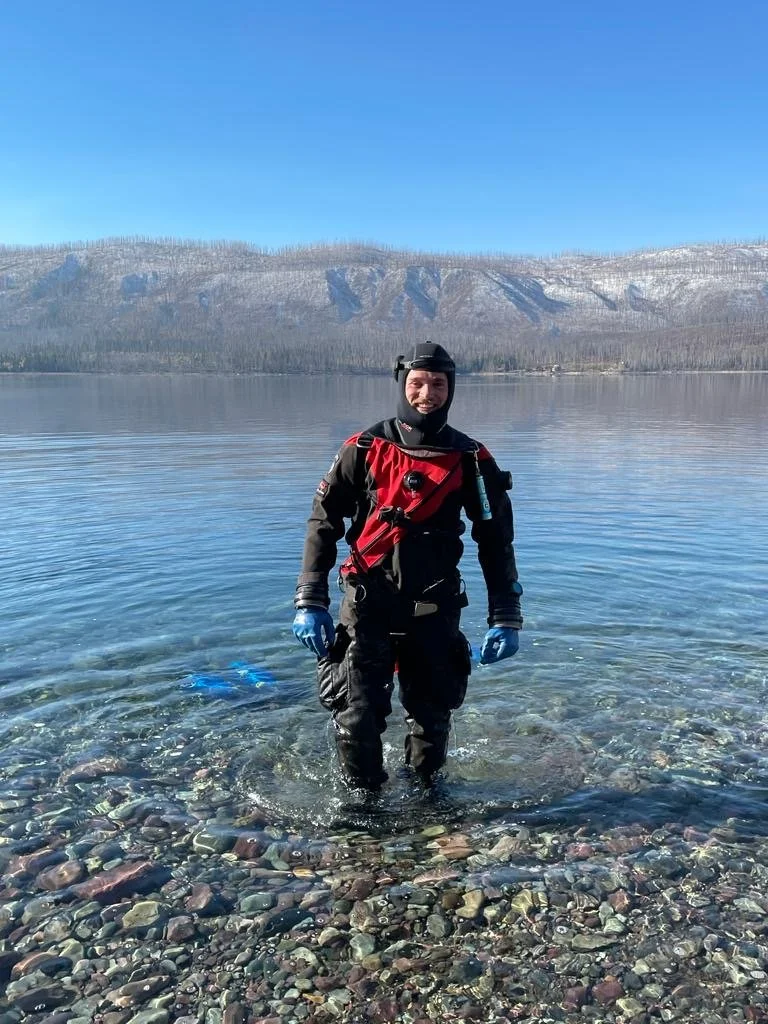
Nicholas (Nick) Mills is the Public Lands Policy Associate Director at the Conservation Lands Foundation.
Why does wilderness matter to you?
I was lucky enough to grow up in Montana with wilderness almost in my backyard and with a wildlife biologist father who would take me out in the field from as early as I can remember. Wilderness means peace and quiet and infinite things to see and explore for myself, but what I enjoy about it is that ecosystems and critters get to continue to live their lives unbothered. That's not too common these days! In addition to land based pursuits, I am also a passionate diver, spending a lot of time in Southeast Alaska and Florida. In doing so, I've learned how wilderness can be so critical to marine ecosystems and things we can't even see with our own eyes often. Wilderness matters to me because I will never see it all, and I take peace in knowing that there are beautiful places that are existing as is.
Why does wilderness matter to your community?
In Bend, wilderness matters in ample ways. From a financial standpoint, the recreation community catalyzed by mountain biking, in bounds and out of bounds skiing, backpacking, hiking, rafting, etc, leads to millions of dollars for local businesses, guides, and more.
In terms of hobbies, pretty much everyone here has their identity partially defined by wilderness, because if you live in Bend you probably have an outdoor pursuit that is best completed in wilderness or wilderness adjacent areas. Without wilderness, Bend would probably just be a dust filled ghost town.
Share a story about a special experience you have had in wilderness.
Two summers ago, my good friend and I did a backpacking trip in Central Oregon's Mt. Jefferson Wilderness in July. This time of year is brutal for finding available permits, especially since we were going around the July Fourth Holiday. The only area with permits available was Mt. Jefferson. Thinking that people must be missing out on a gem, we eagerly snagged the permits and headed to the trailhead—their loss is our gain! It turns out that our four day trip consisted primarily of bushwhacking through shin deep snow and mosquitos so bad that we started to feel crazy. Probably explains why we didn't see anyone else in this area. But the crystal clear blue ponds formed from glacial runoff and the blooming paintbrush reminded me (as cliche as it sounds) that there is always beauty in wilderness, even when hundreds of mosquitos are constantly sucking your blood and you're not really sure where the trail is.
What are your hopes for the future of wilderness?
As development pressures persist, it seems like truly natural and untouched places are becoming more and more uncommon. I hope that the future of wilderness will be led by a new coalition of stakeholders that rethinks who can advocate and enjoy these places. I believe that in order to protect and preserve wilderness and nature, we need to reach new people—such as those in urban areas who have previously been on the periphery of wilderness advocacy. I hope that advocates for wilderness in the future cast a wide net—across the political spectrum and various backgrounds—to protect these places but crucially make it so wilderness is not led by any certain group or background. Rather, I hope wilderness will be viewed as something that can be accessed, enjoyed, and loved by all. I've had the privilege of growing up around wilderness, and of course that has shaped my perspective on what protection means. But as I've pursued a career in this field, I've also seen how groups have been systematically excluded from decisions surrounding wilderness, even if they have lived on the landscapes longer than most. I believe this is changing, and I hope that the future of wilderness truly takes inclusivity into account. I really think that the conservation and wilderness protection movement will only be successful through diverse coalitions and support, and that takes time and trust to build.